
Electronic Commerce and the Consumer
A 1997 talk on why consumers were hesitating over online shopping, what that meant for bank delivery channels, and the privacy law Australia did not yet have.
This is a talk I gave at the Finance Industry Reform conference in Sydney in 1997, while a Senior Consultant at Hewlett-Packard Australia. I had forgotten it entirely; it surfaced in August 2026 in a backup of my home machine, and it is listed under “Publications” in the CV I was keeping at the time.
Nothing records the conference date. The deck carries a revision history running back to May 1995 and was last printed on 14 August 1997, which is the date used above — it is when the talk was ready, not necessarily when it was given.
Two versions survive. This is the longer one, ECOMCON.PPT, thirty-three slides across twenty-one revisions, and the only one that was ever printed. A week later I made a shorter cut, ECOM.PPT, which re-templates the deck, normalises the slide titles to headline case, retitles two of them, and stops six slides earlier — dropping the closing section on future trends, transaction costs, virtual banking and payment methods. Both are linked below so the difference can be checked.
The deck is set out here as prose, in its own order. Its diagrams are a mix of my own analysis and Hewlett-Packard’s product marketing of the day, the latter built from licensed clip art; those I describe rather than redraw, and the original is archived so anyone can see them. Where a slide’s content is a table or a set of figures I have set it as a table, because that is what it is. The percentages are transcribed from the pie charts’ own labels, and every one of the seven pies sums to exactly 100, which is the check that they were read correctly.
One conversion hazard is worth naming, because it nearly cost a fact. Every line of a title or a bullet is drawn twice in this deck, once as a drop shadow, so the extracted text doubles. Collapsing repeated lines removes the doubling — and also removes any line the author genuinely repeated. In the table below, the number of customers is “High” in both the Present and the Future column, and a blanket collapse silently deleted one of them. The doubling turns out to affect only titles and bullet placeholders, never table or diagram text, so there is no safe blanket rule; each slide here was read from its rendered image.
The spelling is as I wrote it, including “mananged”, “should’t” and “Area of ITFocus”.
Checked line by line against the deck afterwards: of its 499 distinct lines, 440 appear here or in the figure — 375 word for word, 65 reworded where a slide bullet became a sentence. Of the 59 that do not, all but a handful are labels inside the Hewlett-Packard product diagrams described rather than transcribed above; the handful are phrases too short for the check to match, such as “Save time / money”, which is here. Running that check is what turned up the source and caption on the final chart, which I had missed.
Download the original deck (PowerPoint, 1.3 MB) — and the shorter later cut (PowerPoint, 1.7 MB).
Agenda
The evolution of electronic commerce. New trends and development in electronic delivery. Future and shape of delivery system. The death of privacy? How to avoid pitfalls. Implementation considerations.
The evolution of electronic commerce
Corporate presence on the Internet had moved a step a year:
- 1994: Corporate presence
- 1995: Sales and marketing channel
- 1996: Target marketing
- 1997: Electronic commerce/banking
- 2000: New delivery channel?
On what electronic commerce actually amounted to in 1997, I quoted someone else’s line: “Electronic commerce is a lot like teenage romance – everyone says they are doing it, but no one really is.” The reality was three distinct segments: EDI; intranet applications such as expense and medical reimbursements and stock purchases; and selling goods and services.
A diagram of the evolving electronic marketplace put “The Network” at the centre and arranged around it the parties and the services that would have to exist for any of this to work: consumers and businesses; merchants offering on-line digital content and traditional products; financial services and financial networks; electronic marketplace services covering certificate authorities, payment and commerce, e-cash and token services, and loyalty services; hosting services; financial and retail purchasing outlets such as merchant malls; secure Internet credit card processing over SET; and, binding them, electronic relationships maintained through certificate authority processes.
The hesitant electronic consumer
The driving force was that consumers have less time but want higher levels of service and interactivity. Against that:
- 30% of online users had made electronic purchases (Dataquest 1995), but the percentage was not increasing rapidly.
- They tended to buy products suitable for online shopping.
- The top reason for holding back was usually fear of credit card security — yet the credit card was the most common method of electronic payment.
That last pair is the whole problem in two lines. The instrument people distrusted was the instrument they were using.
Implications for financial institutions
Consumers need a compelling reason for electronic commerce: save time or money, a unique product, service or experience, customisation, or a reward for continual usage.
Online financial services looked more promising than online shopping. 60% of online users had done online banking (Inteco, Spring 1996), it linked with the use of personal finance software, and it offered automation and better access to information.
New trends in electronic delivery
The channels — branch, ATMs, teleservicing and online — were not a sequence of replacements but an accumulation, and the drivers behind each differed by decade. Four overlapping adoption curves ran face-to-face contact through the 1980s, call centres and then integrated call centres through the 1990s, and customers online into the 2000s:
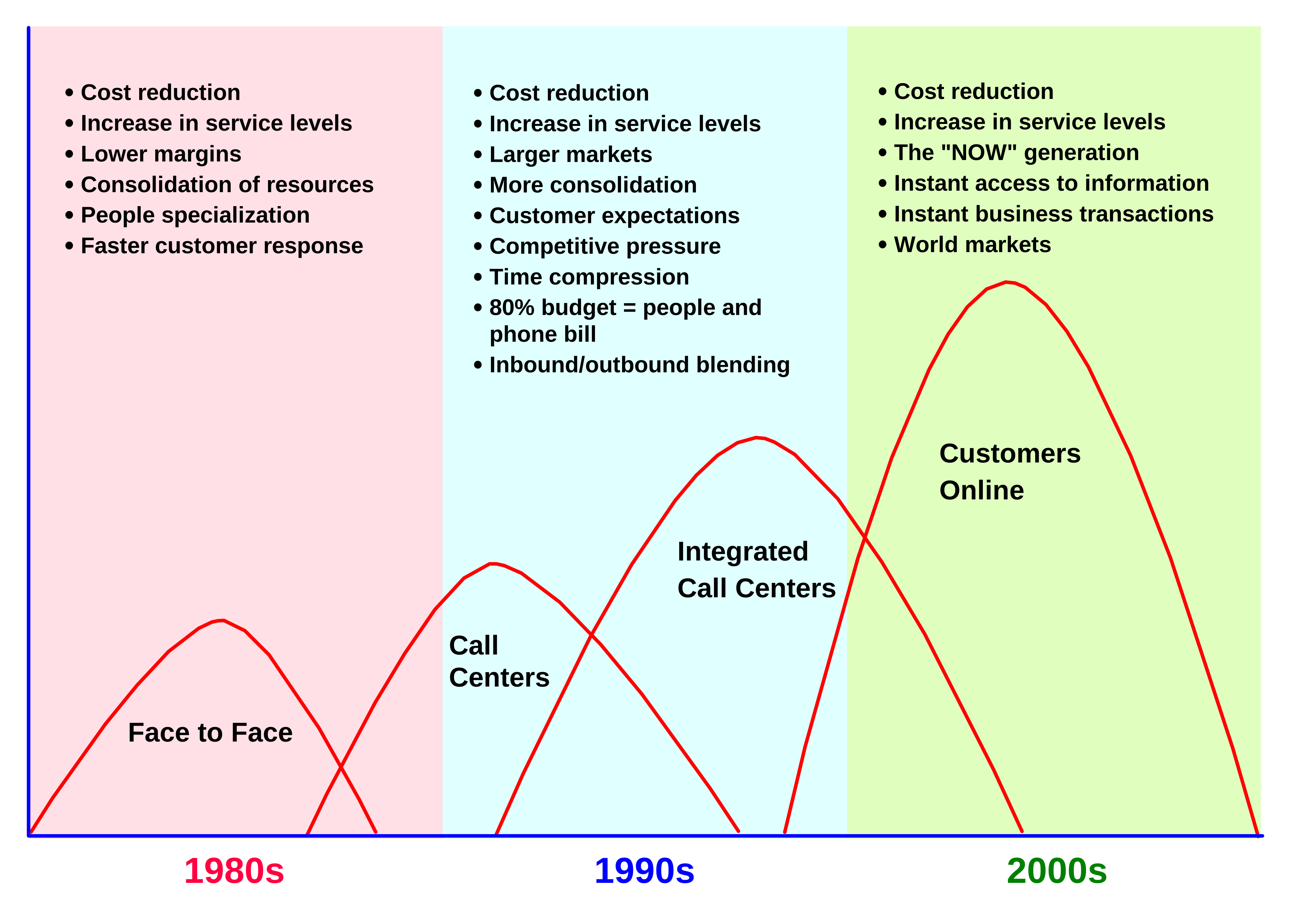
Cost reduction and increased service levels head all three driver lists. The rest is what changed.
Trends in financial services
| Past | Present | Future | |
|---|---|---|---|
| # Channels | Few | Several | Many More |
| # Products | Few | Many | Many More |
| Product Type | Simple | Complex | More Complex, Packaged |
| # of Customers | Low | High | High |
| Type Of Customer | Loyal/Differentiated | Less Loyal/Demanding | Unloyal/Sophisticated |
| Price Flexibility | None | Some | More |
| Market Growth | High | Flat | Flat/Negative |
| Competition | Low | High | Higher |
| Differentiation | Product | Distribution | Value & Convenience |
| Strategic Concern | Growth Management | Cost Cutting | Profitable Revenue |
| Business Model | Mass Production | Mass Marketing | Mass Customization |
| Orientation | Internal | Internal/External | External/Internal |
| Area of ITFocus | Process Automation | Channel Diversification, Integration | Channel Integration, Risk, and Relationship Management |
Supporting statistics
- Non-branch transactions > 50%.
- Non-branch activity growing at 15% per year.
- By the year 2000, US$46 billion will be mananged via self-service channels (Tower Group).
- Branch transaction costs are 50 times that of on-line banking (Gartner Group).
- By the year 2000, it is estimated that 150 million people will be Internet/Web users.
- By 2005, over 75% of households will use on-line banking, and by 2010, over 95%.
Retail delivery channel usage
Across all households, the channel split stood at telephone 24.0%, ATM 31.0%, branch 43.0% and other 2.0%. Households themselves divided into branch-oriented users at 44.0%, self-service oriented users at 37.0% and mixed channel users at 19.0%.
Splitting the two apart shows where the movement was expected. Each row sums to 100%:
| Segment | Year | Telephone | ATM | Branch | Other |
|---|---|---|---|---|---|
| Branch oriented | 1993 | 14.0% | 3.0% | 82.0% | 1.0% |
| Branch oriented | Projected 2000 | 26.0% | 3.0% | 69.0% | 2.0% |
| Mixed channel | 1993 | 12.0% | 38.0% | 49.0% | 1.0% |
| Mixed channel | Projected 2000 | 33.0% | 38.0% | 21.0% | 8.0% |
| Self-service oriented | 1993 | 35.0% | 41.0% | 20.0% | 4.0% |
| Self-service oriented | Projected 2000 | 41.0% | 36.0% | 5.0% | 18.0% |
The telephone, not the Internet, is doing most of the work in every one of those projections.
An electronic marketplace model then set out the transaction and information services connecting buyers and consumers to sellers, merchants and retail, through customer and credit-card-issuing banks, merchant and credit-card-acquiring banks, a trusted certificate authority, and the transaction networks — credit, debit, ACH, SWIFT.
The death of privacy?
- No national privacy law for the private sector.
- Increasing capture of personal information from electronic commerce.
- Used for “profiling” and “segment of one” marketing.
On Australian consumer attitudes, citing the Privacy Commissioner’s public polling from 1990 to 1994: Australians are concerned about privacy; threatened by use of personal information captured on computers; want control over such information, and legislated safeguards; and are not sure how to protect against privacy.
Define and implement a privacy policy
- Disclose what is being collected & purpose of use.
- Ask for consent before using information.
- Allow user to view/modify information.
- Avoid ‘spamming’ (unsolicited emails and contacts).
- Do not penalise users who want to be anonymous.
- Provide value back to user in exchange for collecting information — “thank you” gifts and special offers, and customise information displayed based on preferences.
That list was written four years before the Privacy Act was extended to the private sector, and about twenty before most of it turned up in legislation elsewhere.
How to avoid pitfalls
Lesson 1: You should’t avoid pitfalls. Better to be first — more than 40% market share — and make some mistakes, than to be late and locked out. Detect mistakes early, and be prepared to change if things are not working.
Have a valid business case and strategic focus for electronic commerce. Don’t just build a web page because “everyone has a corporate presence on the Internet”. Define target customers, processes and value proposition.
Don’t ignore security, but don’t let it scare you. Implement adequate security measures, and develop mitigation strategies.
Implementation considerations
The challenge was how to add new channels — call centre, teller, EFT/POS, home banking, Internet, kiosk, interactive TV — without multiplying the IT infrastructure behind them, since each was arriving with its own platform, products and services.
The obvious solution, and the deck did put the question mark in the title:
- Re-deploy all the distribution channels around the two main business functions: selling and servicing.
- Implement one single integrated IT infrastructure to enable and support both business functions.
- Isolate business support activities from primary business functions.
A run of slides then set out Hewlett-Packard’s answer to that: a customer service delivery framework fronting every channel from branch and fax to mobile PDA and home TV, over operational and informational layers; a framework architecture of reusable business application objects, distributed services, legacy application integration and enterprise data, on middleware spanning X.400, DCE, TIB, MOM and MQ; and a sample implementation naming the protocols and products of the day — Quicken, Money and MECCA protocols, HTTP, SSL and SMTP, 3270, Encina PPC, SQL and ODBC, Hogan and Olivetti. These are HP’s product slides rather than my analysis, and are in the archived deck.
The security slides were likewise HP’s: an Internet security vision built on smart cards, user authentication, application and authorization security and a trusted operating system; and VirtualVault, which put a trusted gateway between an external web server and internal data, so that a browser’s HTTP request reached a CGI only after the gateway had checked it, and only an approved CGI could touch an intranet data source or legacy application.
Future trends
“In Cyberspace, people can hear you scream …” — a list of who is listening: your employer, your Internet service provider, marketing “spammers”, proxy services, online merchants and banks.
Two Gartner Group predictions, both at 0.7 probability: electronic commerce and marketing will be a key source of competitive differentiation in 1998, and a necessity for staying in business for 70% of large enterprises by 2002; and by 1998 the largest obstacles to commercial development of the Internet will have been resolved, and the pressure for every business to get on the Internet will be enormous.
A bar chart of average cost per transaction set a branch teller transaction against an online one, marking a fifty-fold cost decrease for online transactions, sourced to Gartner Group, August 1995.
On virtual banking: it provides a single view to banking products through an automated delivery channel at any time. Internet banking is online banking across the World Wide Web, often termed “home banking” — it includes but is not exclusively tied to the home, office, a dedicated PC, or a particular software package, and is conducted from any Internet address anyplace, anywhere, anytime.
A closing diagram of Internet-enabled electronic commerce set the same cast against the infrastructure technologies: consumers and merchants, consumer banks, merchant and credit-card-issuing banks, electronic payment handlers, e-cash and token services, secure gateway servers, trusted third-party authentication, commerce applications and enterprise systems, reached from home or remote commerce.
The last chart returned to the opening problem. Asked how they paid, respondents put the online credit card first for both business and personal purchases, ahead of a phoned card number, a mailed cheque, billing to an ISP, an existing account or cash on delivery; the one sharp difference between the two was an existing account with the merchant, common for business purchases and rare for personal ones. The chart is scaled 0% to 60% but carries no data labels, so those are rankings rather than figures. Its source is Inteco, May 1997, and its caption reads: “30% of Internet users surveyed has engaged in electronic commerce activities.”
Consumers, the slide concluded, are not afraid to use credit cards.
Sources
ECOMCON.PPT, thirty-three slides, created 28 May 1995, twenty-one revisions, last printed 14 August 1997, last saved 23 August 1997. Authored “Chris Tham”, built on Microsoft PowerPoint 7.0.ECOM.PPT, twenty-seven slides, created and saved 24 August 1997 across three revisions and forty-seven minutes. A second copy,ECOMXX.PPT, is text-identical to it.- The talk is listed as a publication in my CV of 15 October 1997: “Chris Tham, Electronic Commerce and the Consumer, Finance Industry Reform conference, Sydney (1997).” That CV also lists the conference among those attended in 1997. It is not archived here: it carries a home address and phone number.