
Rogoweb: Rogue and Rog-O-Matic, alive in the browser
The 1980 game Rogue and the expert system built to play it, both compiled to WebAssembly and running side by side in a browser tab. The original C, not a rewrite.
I was halfway through my degree at the University of Sydney when Rogue appeared on the Unix machines in the Basser Department of Computer Science. It was an immediate hit with the students, and the university banned it from being played during the day. So we played after hours instead, at sessions we called Rogue parties. I was never much good at it compared with the others.
Then we got hold of Rog-O-Matic, a program that played Rogue for you. Naturally we all started running it, and it ate so much processor time that the university banned it outright. We used to say we wished we had Unix computers of our own, so that we could play Rogue and Rog-O-Matic all day long.
Forty years later, here they both are, running in a browser tab.
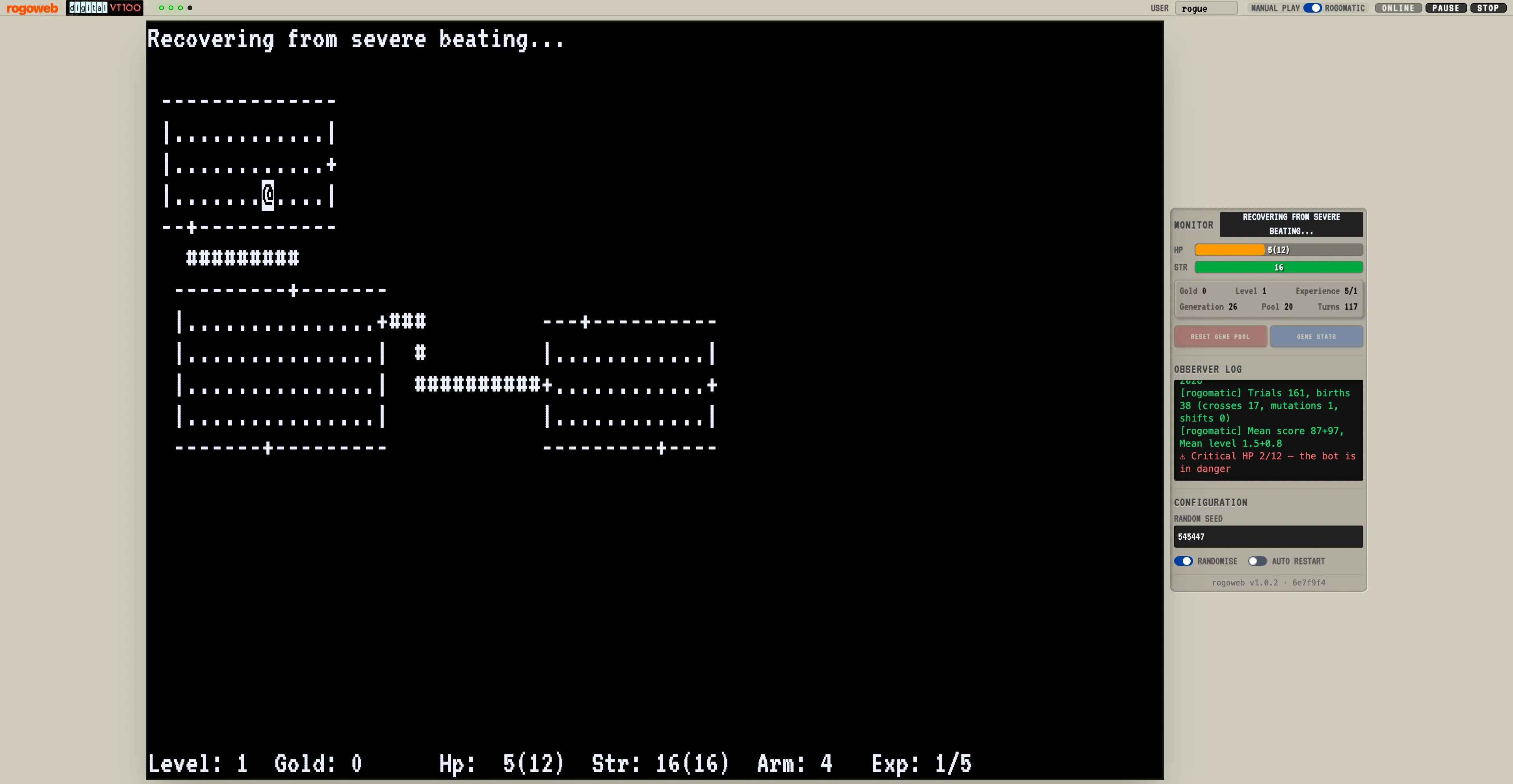
The game, and the program that played it
Rogue is the 1980 dungeon crawler by Michael Toy, Glenn Wichman and Ken Arnold, and it is the game the roguelike genre is named after. The dungeon is drawn in punctuation. Rooms are dashes and pipes, corridors are rows of hashes, monsters are letters, and you are the @. There are twenty-six levels down to the Amulet of Yendor, the whole thing is generated fresh every game, and the monsters get nastier faster than you get better, which is why hardly anybody ever sees the Amulet.
Rog-O-Matic was begun at Carnegie Mellon in October 1981 by Michael Mauldin, Guy Jacobson, Andrew Appel and Leonard Hamey, as what they called a simple project, and it grew into 12,000 lines of C against Rogue’s 8,900. But it never saw inside the game at all. It watched the characters Rogue drew on the terminal, rebuilt the dungeon from them and typed keystrokes back, with its rules grouped into about a dozen “experts” in a fixed order of priority, so that the melee expert’s decision to fight always overrode the object expert’s call to pick something up.
It beat the humans. Between January and February 1983 it played 106 games of Rogue 5.2 at Carnegie Mellon, and against the fifteen best human players there it came out with the highest median score of the lot. Its best game scored 7,730, and in that one it found the Amulet and was killed carrying it back up to the surface.
It ran on a VAX 11/780, the same model of machine the Basser Department had hundreds of us sharing, which managed about a million instructions a second and was hundreds of times slower than the least capable Raspberry Pi. The paper puts Rog-O-Matic’s cost at about thirty seconds of processor time for every dungeon level, with Rogue adding another fifteen for its side of the simulation, and that is one player on a machine of its own. Multiply it by every student who has just discovered the thing, and our ban explains itself.
Not a reimplementation
On Unix, rogue and rogomatic ran as two separate processes, with rogomatic launching rogue and talking to it through the standard input and output pipes. A browser has none of that machinery. There are no processes, no fork, and no pipes.
When I rebuilt every HP calculator I wrote every function again from scratch. Nothing of the sort has happened here. Both programs were compiled to WebAssembly with Emscripten and given a port of curses to talk to, emcurses, which is a port of pdcurses, which is itself a reimplementation of the original curses library. What changed is the plumbing underneath them.
In place of the Unix pipe there is a ring buffer living in a SharedArrayBuffer, which is simply a fixed block of memory that two background workers can read and write in turn. The game runs in one worker, the bot runs in the other, and they talk to each other exactly as they always did, without either of them realising anything has changed.
The telemetry comes out the other way about. Rog-O-Matic plays by scraping characters off the terminal, which was the only way to watch a game it was not allowed to modify. The dashboard is under no such restriction, so rather than scrape the screen for numbers that are slow and error-prone to recover, the C code writes its internal state straight into a corner of that shared memory and the dashboard reads it from there.
How it was built
It took five days. I have written about the method at length in chapter three of my book, but the whole of my brief here was one sentence: port rogue and rogomatic to run in the browser. To that I attached one constraint, that the original C should keep working, and one check, that the bot could still play a game through to the end. Everything above, the two workers and the ring buffer and the shared memory, came back as the answer to those three lines. I would never have thought of any of it.
It passed the check. It kept the constraint too, right up until I decided to break it.
Shared array buffers brought race conditions with them, and the symptom was always the same. The game simply stopped, with one worker sitting waiting on the other for no reason I could see. Now and then I could point the agent at one. Mostly it found them itself, once I had asked it to go looking.
The one thing I did not delegate was the look. It is a VT100, in the putty-coloured case DEC actually shipped, with the digital badge still in the corner.
Teaching the bot to be better
Once the port worked, I got greedy and asked the agent to improve the bot itself. This is the point at which the original code stopped being original, and it was on purpose.
Rog-O-Matic learns. It keeps a genetic pool of strategy weights and a long-term memory of how dangerous each monster has proven to be, and it evolves both across games, saving the results in your browser. A fresh install therefore plays badly and gets better the more it plays.
To hand new players a bot that is already competent, the agent built an offline pretrainer and spread it across every CPU core, running separate populations that evolve in isolation and then merge under a rule that never lets the result come out worse. That trained about ten times faster than evolving one population on one core.
Then it went into the Rog-O-Matic source itself and retuned a set of judgements the original had left mis-set: when the bot heals, when it runs away, when it eats, and how much danger it credits each monster with, which is the one that stops it cheerfully under-rating a dragon. All of them had been sitting in that source since the eighties.
Because Rogue is a game of chance, none of this could be judged on a single run. Each change had to hold up on win rate and average depth across a batch of games, so the agent spent most of its time playing Rogue a few hundred times over to find out whether it had improved a bot from the eighties.
What came out of it plays rather better than I ever did, which I admit was never a demanding test.
Have a go
Play it here. The source is on GitHub.
We wanted Unix machines of our own so that nobody could stop us playing. What we have instead is a browser that will fake enough of Unix to run both programs at once.
Nobody is going to ban it this time.
Sources
- rogoweb, the source, which carries the merged Rogue 5.4 and Rog-O-Matic XIV codebases and the notes on the port.
- Michael Mauldin, Guy Jacobson, Andrew Appel and Leonard Hamey, Rog-O-Matic: A Belligerent Expert System, Carnegie Mellon University technical report CMU-CS-83-144, 1983, for the architecture, the 106 games, the running cost and the Amulet.
- Rogue, Wikipedia, for the game’s origins and its authors.
- Chapter 3 of AI-dō, which describes how the port was built and what went wrong along the way.