
UNIX Password Encryption Considered Insecure
Our 1991 USENIX paper showing that DES-based UNIX password encryption could be brute-forced, with an ECL hardware design that encrypted a password in 6 microseconds.
This is a reproduction of a paper presented at the USENIX Winter ’91 Conference in Dallas, Texas (pp. 269–279), written with Philip Leong. I have transcribed it from a scan of the proceedings: the tables are set as tables and the code re-typed. The wording is unchanged. There is a postscript from 2026 at the end, which is not.
The six figures are the originals. The paper’s own troff source survives, and with it the five xfig drawings it included and the grap block that draws the scatter plot, so the figures here are converted from the files the paper was typeset from rather than redrawn from the scan. Two things about them are worth stating. The type is a little larger relative to each drawing than in the proceedings, because the paper’s Makefile shrank it to fit a three-inch column and nothing here needs to. And the scatter plot’s vertical tick marks are placed at every second millisecond, which is a guess: grap chose them automatically and the source does not record what it chose.
Download the original scanned paper (PDF, 647 KB)
Philip Leong – University of Sydney
Chris Tham – State Bank of Victoria
Abstract
Recently there has been a revival of interest in the security of the password encryption scheme employed in the UNIX Operating System and its derivatives. This resurgence was due mainly to the success of an attack on the Internet by a virus program in November 1988. The current encryption scheme used is a variant of the NBS Data Encryption Standard (DES) modified in such a way that existing DES hardware implementations cannot be used. There is currently no reported way of reversing the password encryption, i.e., to obtain a password from its encrypted string.
In this paper, we show that the current encryption scheme can no longer be considered secure as most UNIX passwords can be decrypted using a brute force search within a reasonable period of time. As an example, all passwords containing only lower case alphabetic characters can be decrypted in less than 15 days.
In order to perform a brute force search, we need the ability to encrypt a UNIX password in the shortest time possible. Accordingly, we present a hardware design of a password encryption device that can encrypt a UNIX password in 6 μs. This device consists of approximately 100 Emitter Coupled Logic (ECL) chips and can be built by any electronic hobbyist for less than $2000. The board can also be used to encrypt DES at 266 Mbps, more than ten times faster than a recent CMOS VLSI design.
We also present a software only implementation of the encryption algorithm recoded for maximum speed. This implementation can encrypt a UNIX password in 1.2 ms on an IBM RS/6000 Model 530 machine.
Introduction
The issue of the security of the UNIX Operating System has long been a subject of debate, resulting in a multitude of conflicting statements made, often by ill-informed parties. Whilst it is probably true that the system is “… more secure than any other operating system offering comparable facilities” [Duf89a] it is also true that UNIX has never been designed with security features foremost in its implementors’ minds. [Rit78a]
The UNIX protection model has been extensively described in existing literature [Rit78a, Gra84a, Bac86a] and will not be detailed in this paper. It is sufficient only to know that UNIX security is based on the concept of users and groups. A user is a uniquely identifiable entity within the system and belongs in one or more groups. Users may own resources in the system such as processes, files and devices. Access to these resources is maintained by the owner who can control access by other users or a specific group. To gain access to a UNIX system, all users must undergo a login procedure either explicitly or implicitly. The login procedure requires the knowledge of a valid login name and a password associated with the user. The password is used to authenticate the user. (An implicit login occurs when accessing a machine through a network using utilities which may bypass the interactive login procedure.)
Once through the login procedure, access to resources in the system is validated through the user/group protection mechanism. In addition, there exists a special user known as the super-user who has the ability to transcend the protection scheme to access any resource in the system.
Although there are various ways of compromising the security of a UNIX system, nearly all of them involve either (a) an unauthorized person or program gaining access to the system by knowing the password associated with an authorized user, or (b) an authorized user ‘masquerading’ as another user, preferably the super-user, in order to gain access to unauthorized resources in the system.1 In any case, any intrusions into a system or network must first begin with the knowledge of the password of an existing authorized user. Hence, the security of a UNIX system hinges on the security of its password authentication scheme.
On November 2, 1988, a self replicating program was released on the Internet (a logical network of many physical networks of predominantly UNIX machines) which uses the resources of machines on the network to replicate and spread itself. This program, alternately described as the Internet Worm and Internet Virus, [Eic89a, See89a, Spa88a] caused a major disruption to the operation of the Internet and incensed the members of the Internet computing community comprising thousands of academic, corporate and government users. It sparked our interest in investigating the effectiveness of the UNIX password encryption system as one of major methods of attack employed by the program involved the guessing of UNIX passwords through repeated executions of a password ‘cracking’ routine in the program. The implementation of the encryption routine used by the program was different from that used by the UNIX system itself and is up to nine times faster than the UNIX version. [See89a]
Description of the UNIX password encryption algorithm
The login(1) program in the UNIX System implements the login procedure and attempts to authenticate access to the system. A file called /etc/passwd contains a list of all valid users on the system, including their login names and encrypted passwords. This file, strangely enough, is readable by any user on the system. When a user tries to gain access to the system, she or he must first type in a valid login name. The login program prompts for a password associated with the login name. This password is not echoed back to the user as it is typed in. Once typed, the program calls a standard UNIX library function called crypt(3) which encrypts the password into a printable ASCII string. The login program then compares the results of the encryption with the encrypted password in /etc/passwd. If the two strings are equal, the user is allowed entry into the system and the program then sets up the user environment and executes the user’s command interpreter on behalf of the user. If the login name that has been typed in does not match a valid user on the system, or if the encrypted password does not match the encrypted string, the program prints the string “Login incorrect” and redisplays the login prompt.
Obviously, the design and implementation of the crypt() function is crucial to the security of the login procedure. The encryption performed by crypt() must be irreversible, i.e., it should be impossible to derive the clear password string given the encrypted form of the string, even when the source to the encryption routine is available.2 In addition, the encryption algorithm must be reasonably compact, given the hardware limitations of the machine on which UNIX was originally designed for, and yet take up a substantial amount of computing time to execute. This last requirement serves to prevent the use of key search cryptanalytic approaches.
The original implementation of the encryption algorithm was a variant of the M-209 cipher machine.3 The password was used as the key for the encryption of a constant text string and the result of the encryption was returned. Morris & Thompson [Mor78a] notes that a version of this algorithm optimized for maximum speed could encrypt a password in approximately 1.25 ms on a DEC PDP-11/70 minicomputer. This was considered unacceptably fast as it permitted the use of key search techniques in password guessing programs.
Table 1: Computing the key schedule
The version currently in use is based on the Data Encryption Standard (DES) announced by the National Bureau of Standards (NBS) for use in unclassified United States Government applications in 1977. [Ano77a, FIP75a, Seb89a] The DES uses an algorithm called the Data Encryption Algorithm (DEA) specified in the American National Standard ANSI X3.92-1981. [ANS81a] The first eight characters of the user’s password are used as the DES key, a constant 64-bit block (consisting of all zero bits) is then encrypted via DEA 25 times (the result of each encryption being used to feed the next round). Finally, the resultant 64-bits is converted into a string of 11 printable ASCII characters by encoding every six bits into a printable ASCII character and zero padding the 11th character.
The DEA is a fairly convoluted series of bit permutations, expansions and selections optimized for efficient hardware, rather than software, implementation. It requires a 64-bit key to be used to encrypt every 64-bit block to a 64-bit encrypted block.
The key is only effectively 56-bits long as every eighth bit is ignored by the algorithm. is used to compute a key schedule of 16 48-bit subkeys ( to ). A permuted choice () function transforms into two equal 28-bit halves ( and ). These halves are rotated independently by specified amounts () and then run through another permuted choice () yielding the 16 48-bit keys. Table 1 summarizes the key schedule computation.
The actual encryption algorithm itself will encrypt a 64-bit block into another 64-bit block . undergoes an initial permutation called which is then split into two equal halves called and . Each half is then alternately passed through the function which expands the half into a 48-bit block through the expansion, bitwise exclusive-ORs () with one of the subkeys in the key schedule (), performs selection () and permutation () operations before exclusive-ORing the 32-bit result with the other half. After 16 applications of the function, the halves are then rejoined back into a 64-bit block and the result undergoes a final permutation () yielding the encrypted block . Table 2 summarizes the operation of DEA.
Table 2: DEA operation
One interesting twist in the implementation of the DES algorithm in the UNIX crypt() function lies in the salting of the encryption. Stored together with the encrypted password is a 12-bit salt encoded as two printable ASCII characters. The crypt() function expects the salt to be passed to it along with the clear password text. The salt () is used to perturb the expansion in the following manner. Let be the standard expansion function and be the perturbed expansion function. Then and is related:
Table 3: Effect of the salt on the E expansion
When a password is first selected for a user, the password encryption program passwd(1) selects a random 12-bit number as the salt. The clear password string is then encrypted using this salt and the result is stored in the password file. Later on, when the user attempts to login to the system, the salt is extracted from the password file and is used to encrypt the user’s typed password. The effect of salting is to allow for 4096 possible encryptions of the same password string.
Obviously, the use of salting does not necessarily improve the strength of the encryption. In fact, especially since the mechanism of DEA is not well understood by cryptanalysts who do not have access to classified files explaining the algorithm, it is possible that salting may have weakened the encryption process. However, the modification was done in order to prevent the use of hardware DES implementations in speeding up key searches, and also to prevent password cracking programs from precomputing commonly used passwords and storing them in a file or array and thus bypassing the (slow) encryption process.
On the surface, the UNIX crypt() function appears to have fulfilled all of its designers’ aims. It is compact, appears at this stage to be irreversible, and software implementations of DEA tends to be slow, a password taking more than one second of CPU time to encrypt on a PDP-11/70.
However, there has been many doubts casted upon the strength of DES, including disagreement over whether a 56-bit key was sufficiently strong. Diffie & Hellman [Dif77a] predicted in 1977 that the DES algorithm could be compromised by a dedicated machine with around one million chips that can be built for around $20 million. This machine could then search the complete key space in approximately one day. They also predicted that by 1990 hardware speeds would have improved so much that a 56-bit key would no longer be secure. The NCSC no longer certifies DES for even unclassified government information, a sure indication that DES is no longer considered secure. Furthermore, 25 applications of DEA does not necessarily improve the security of the basic algorithm, especially since the key schedule does not change between passes.
Most recently, Ali Shamir and Eli Biham [Sha89a] have reported that a chosen plaintext attack can reverse the DES encryption process in a time less than that required by exhaustive key search provided less than 16 rounds of the function are run. It will be interesting to see if a variant of this method can be used for reversing the UNIX password encryption process, although this seems unlikely since the crypt() function uses applications of the function.
Hardware implementation
In order to design hardware which will decrypt passwords in as short a time as possible, we must use components with a very small propagation delay. To this end, we chose the ECL 100K logic family.
f function
The function forms the heart of DEA and a password encryption involves 25 applications of DEA each of which make 16 applications of . Figure 1 shows a block diagram of the function.
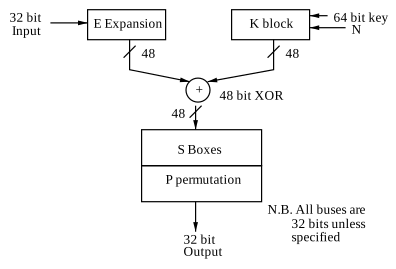
Figure 1: The f function. All buses are 32 bits unless specified.
E expansion
The main difference between DEA and crypt(3) lies in the salting of the expansion operation which outputs a 48-bit block from a 32-bit input. In DEA, this expansion is always performed in the same way, so we could implement this by rearranging the connecting wires. For crypt(), the bits in the output of the expansion may be exchanged according to the value of the salt.
The exchange of output bits involves only optionally crossing two connections depending on whether a particular bit of the salt is set or cleared. Thus, the exchange can be implemented using 12 two-pole changeover relays, one for each bit of the salt. Each relay acts as a crossbar connection controlled by a bit from the salt, thus allowing the 32-bit input to pass through the normal DES expansion and then through the salt-dependent permutation (see Figure 2). Since the salt need only be set once for each user, the speed of switching of the relays does not matter. Furthermore, during the encryption process, the signal only passes through the relay contacts, and so no propagation through logic gates is required. Hence the difference between the expansion of DES and crypt does not affect the speed of this hardware encryption device. Figure 2 shows a block diagram of the expansion and Figure 3 shows a blowup of a salt box.
![Block diagram of the E expansion. A 32 bit input enters an E expansion box whose 48 bit output feeds a tall column of twelve salt boxes, Salt Box 1 at the top through to Salt Box 12 at the bottom, ending in a 48 bit output. Salt bits salt[0], salt[1], salt[2] and salt[11] enter their boxes from the left](/cv/_astro/crypt91-figure-2.DQv7epnH_Z2cdKnR.svg)
Figure 2: The E expansion
![A blowup of one salt box. Forty-eight lines run down through a wide box, the leftmost labelled 1, then i, then 24 prime, then 48 at the right. Lines i and 24 prime cross over inside the box, drawn as dotted diagonals; the others run straight through. salt[i] enters from the left](/cv/_astro/crypt91-figure-3.DDe8Pwmv_3bBMF.svg)
Figure 3: The Salt Box
Key schedule
The key schedule converts into a 48-bit block depending on the iteration number. Thus the subkey for the -th iteration is which is a selection of . Our method of calculating the key schedule is generate all 16 key schedule values for each of the 48 bits of output, and then use a 100164 1-of-16 multiplexor to select the desired output for any given iteration (see Figure 4).
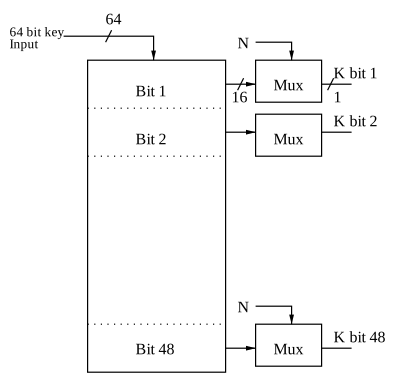
Figure 4: The key schedule
XOR of the E expansion with Ki
This 48-bit XOR is implemented using 10 100107 quint XOR gates which have a maximum propagation delay of 1.7 ns.
S selection and P permutation
The XOR described above is passed through the selection boxes and then permuted. Note that the boxes are arranged as 8 groups of selections of 4 bits from 6 bits, and so 8 64x4 bit ECL RAMS are required. We use 100422’s which have 5 ns propagation delay from the address input to the output. The output is then permuted according to the permutation which just involves crossing of wires.
Final XOR
To complete the function we do the 32-bit XOR of the output of the above permutation with the leftmost 32 bits of the previous iteration.
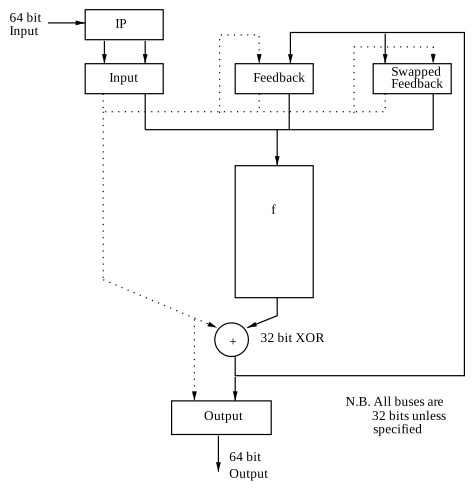
Figure 5: Block diagram of the DES hardware. All buses are 32 bits unless specified.
Block transformation
Block transformation involves the exchange of the leftmost 32 bits of the 64-bit word with the rightmost 32 bits. As shown in Figure 5, we have three latches that can feed the function, and this allow us to optionally perform block transformation or clear the 64-bit input to . Clearing is required at the start of the crypt operation. The three latches are wire-ORed together and the two latches not being used are cleared. The three 64-bit latches require 33 100151 hex flip-flops.
State machine
A finite state machine controls the flow of information through the circuit. It must feed the key schedule computation unit with the correct iteration number, select the correct input to the function from the three latches and latch the output result when the computation has been completed. Figure 5 shows a block diagram of the hardware.
Note that DES can be implemented using the same hardware by setting the expansion relays to flow straight through. Then the main difference between crypt and DES is that crypt performs 25 iterations of the DES algorithm.
Operating frequency
The gate delays for a single iteration of the algorithm are the delays for 2 XORs, 1 multiplexor, 1 RAM and one latch which totals to a worse case of 14.7 ns. We use a cycle period of 15 ns which corresponds to a frequency of 66 MHz. Hence it takes 6 μs to encrypt a password.
As a DES encryption machine, the board can process 64 bits every 240 ns, that is, at a rate of 267 Mbps. It is interesting to note that a recently reported single chip implementation of DES [Ver88a] operates at 20 Mbps.4
Software implementation
Although a hardware implementation of crypt() is within range of a determined cracker, we also decided to implement a fast software version. This implementation is substantially faster than the UNIX routine and is portable across any hardware platform with native 32-bit operations. Interestingly, our implementation does not discriminate against either big endian or little endian machines, although as currently implemented, it seems to shine on RISC (Reduced Instruction Set Computer) architectures due to the fact that the implementation does not tend to require complex instruction addressing modes but requires a fast basic instruction execution cycle, two characteristics which have been used to describe RISC architectures. Our implementation was written in Australia and is hence free of any US export restrictions.
A good description of the Internet Worm/Virus implementation of crypt() is given in Seeley [See89a] and we used this implementation as a base for our own approach. Our initial implementation encrypted a password on the Sun Sparcstation 1 in just over 6 ms. The performance of this implementation was disappointing compared to Bishop [Bis88a] so we reimplemented the program using these new ideas. This resulted in an implementation that encrypts a password on the same machine in just over 2 ms. The following notes describe our second implementation.
The basic speedup over the UNIX implementation was due to bit compaction into machine words. The UNIX implementation uses one byte to store every bit that needs to be manipulated. Hence, 64 bytes consisting of the numbers 0 and 1 were used to represent a 64-bit entity. In our implementation, the same entity is represented by two 32-bit words. This allows us to use the rotate and exclusive OR operations in the instruction set, and hence exploit the inherent parallelism in the data-path of the CPU. Also, we precomputed all expansion, selection, and permutation functions and in many cases combined several operations into one precomputed array.
As an example, the , , operations can be effectively combined into a single operation which we call . This operation can then be precomputed so that instead of performing the operation on every bit in the 56-bit key yielding a 48-bit subkey, we can divide the original 56-bit key into eight groups of 7-bit blocks. Each 7-bit block is used to index into an array of precomputed 48-bit blocks. The eight resultant 48-bit blocks are then ORed together to form the subkey. As an example, we declare and precompute an array used for key schedule computations called keys, the DES key is in the array k and the computed key schedules will be stored in the array keysched:
typedef unsigned long Word;
typedef unsigned char Byte;

static Word keys[16][8][128][2];
static Byte k[8];
static Word keysched[16][2];
Note that two Words are used to store the 48-bit quantity, which is divided into 24-bit halves, each of which fits in the 32-bit machine word. For example, to compute the i th subkey, all we need to do is to use each byte in k to index into the keys array and then OR the results into the keysched array.
keysched[i][0] = keys[i][0][k[0]][0] |
                 keys[i][1][k[1]][0] |
                 keys[i][2][k[2]][0] |
                 keys[i][3][k[3]][0] |
                 keys[i][4][k[4]][0] |
                 keys[i][5][k[5]][0] |
                 keys[i][6][k[6]][0] |
                 keys[i][7][k[7]][0];
keysched[i][1] = keys[i][0][k[0]][1] |
                 keys[i][1][k[1]][1] |
                 keys[i][2][k[2]][1] |
                 keys[i][3][k[3]][1] |
                 keys[i][4][k[4]][1] |
                 keys[i][5][k[5]][1] |
                 keys[i][6][k[6]][1] |
                 keys[i][7][k[7]][1];
Note that all arrays are declared as static variables rather than left on the stack so that the compiler can generate actual memory references or memory plus register offset references rather than indirect stack references. This significantly speeds up code execution on CISC (Complex Instruction Set Computer) machines. The subkey computation loop was also unrolled to simplify the compiler address generation.
A similar technique is used to perform the function and the final permutation.5 In the function, we note that accepts a 32-bit argument, which then immediately expands to a 48-bit block through the expansion. The result of the function is a 32-bit number which is then exclusively ORed with another 32-bit number and then fed into the next invocation of the function. First of all, note that since is an expansion which maps every 32-bit block into a unique 48-bit block, we can obtain the inverse of which we shall call .
Suppose we define a function such that then we notice that . In other words, we can combine the , and operations into a single operation that can be precomputed. We can then transform the DEA algorithm into 16 applications of the function followed by application of on both halves which is then fed into the final permutation.
Bishop [Bis88a] gives a full mathematical treatment of the modified algorithm outlined above. Finally, we note that the effect of salting can be obtained by exchanging bits of the result of the expansion. Given that we are representing a DES block as two machine words, we can calculate the salted expansion by performing several exclusive-ORs and one bitwise AND (&) operation.
Table 4: Salting the E expansion
In our actual implementation, we reinitialize the precomputed array given a new salt in order to save the time required to perturb the result of the expansion. This is because in a password cracking situation, the cost of precomputation whenever the salt changes is insignificant as many password guesses are made for every encrypted password.
Guessing passwords
We shall not describe the design and implementation of the Internet Worm/Virus’s password cracking routines because it has already been documented in existing literature, [Eic89a, See89a, Spa88a] although the methods it uses can be generalized for any password guessing program. Essentially, a password guessing program works by reading in the password file and then making multiple guesses of the password of every user or selected users in the password file. The selection of password guesses is vitally important as the better the quality of the guesses, the greater the chance of actually hitting the correct password within a given period of time.
Each password guess has to be encrypted using the current salt and then matched against the encrypted password. Obviously, the effectiveness of this procedure strongly depends on how fast a password can be encrypted. Ideally, the encryption process should take almost no time so that a complete key search can be done. Since we know that the encryption process takes up a significant amount of time, even with hardware assistance, it is more effective to implement a good password guessing generator and use brute force search only as a last resort.
A password guesser should make intelligent password guesses which is dependent on the personality traits and characteristics of the person who has chosen the password. Ideally, personal information concerning the password creator should be known to the program, such as names and birth dates of people, car registration numbers etc. In practise, this information is very hard to obtain, but a good start can be made by scanning the password file itself for information about users. The password file often stores very useful pieces of information which can be used, such as the user’s full name, his/her phone extension and/or office number. A password guesser should certainly try permutations of the user’s login name, full name and any other detail known about the user. Searches through lists of words or combination of words can also be effective. These may include lists of first and last names, words occurring in a special context (swear words, technological jargon, biblical and mythological names), or even dictionaries.
If a brute force search is attempted, this can be made more efficient by ordering the keys searched so that common characters and sequences of characters appear first in the search. Any additional information such as the first character of the password or even which side of the keyboard it was typed on, will dramatically reduce the time required to decrypt a password.
Table 5 shows the speed of our software implementation of crypt on a wide variety of machines. Figure 6 summarizes the results of this table in a scatter plot.
| Machine name | CC | Time (ms) |
|---|---|---|
| Sun 3/50 | cc -O4 | 16.0 |
| Sun 3/60 | cc -O4 | 9.5 |
| Sun 3/60 | gcc -O | 7.2 |
| Pyramid 9810 | gcc -O | 6.3 |
| DECstation 2100 | cc -O | 3.3 |
| Sparcstation 1+ | cc -O4 | 2.0 |
| DECsystem 5000/200 | cc -O | 1.8 |
| IBM RS/6000-530 | cc -O | 1.2 |
| ECL hardware | n/a | 0.0060 |
Table 5: crypt() speed comparison
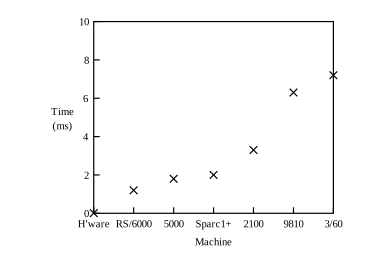
Figure 6: Scatter plot of crypt() performance. It plots seven of Table 5’s nine rows: the two slowest, the Sun 3/60 under cc -O4 at 9.5 ms and the Sun 3/50 at 16.0 ms, are left out. The plot is drawn on a grid running 0 to 6 across and 0 to 10 up, which has room for seven points and none above 10 ms.
Table 6 demonstrates the speed difference between hardware and software implementations and also shows the time required to decode a password using a brute force search. The software times were extrapolated from the RS/6000 encryption time. It is easily seen that for lower case alphabetic characters (which form the majority of passwords), it is very feasible on our hardware. The table also shows that such brute force searches are not possible in software on commonly available workstation class computers.
| Search criterion | Number of passwords | H’ware (days) | S’ware (days) |
|---|---|---|---|
| Lower case only | 14.5 | 3712 | |
| As above + digits | 196 | 39182 | |
| All alphabetic | 3712 | 742496 |
Table 6: Brute force search times
It is interesting to note that the original UNIX password encryption algorithm based on the M-209 cipher machine was changed because it could be implemented on a PDP-11/70 in 1.25 ms and this was deemed to be too fast. [Mor78a] Since even our software version can perform a password encryption in less time than this, it may be time to change the current method of encryption yet again.
There are a number of possible improvements to password encryption algorithm that will significantly decrease the success ratio of a password encryption program that uses our hardware or software implementations of the crypt() function. An easy method would be to use the next eight characters of the password as the initial input to the DEA and then modifying the passwd(1) program to only allow passwords longer than eight characters. Alternatively, a concept similar to the shadow password file idea can be implemented by UNIX administrators to stop users and/or programs from reading the password file.
These implementations are by no means the last word on speedy password encryption. It is certainly tempting to imagine the speedup that can be obtained using a massively parallel computer such as the Connection Machine [Hil85a] or through the use of a large array of custom VLSI chips which can test passwords in parallel.
Conclusion
A design of a very fast hardware encryption device has been presented in this paper. Such a device makes brute force searching of passwords possible due to the small key space from which people normally select passwords. It was shown that perturbing the expansion of the DES algorithm with the salt does not result in any change in the speed of the implementation of crypt() in hardware, although applying DES 25 times reduces the speed at which we can encrypt passwords by a factor of 25.
A software implementation of the UNIX password encryption algorithm was also presented, and the speed of this implementation was compared with that of the custom hardware.
References
- Ano77a. Anon, ‘Data Encryption Standard,’ FIPS PUB, (46) National Bureau of Standards, (15 January 1977).
- ANS81a. ANSI, American National Standards Data Encryption Algorithm, American National Standards Association (1981).
- Bac86a. Maurice J. Bach, The Design of the UNIX Operating System, Prentice Hall International, Inc. (1986).
- Bis88a. Matt Bishop, ‘An Application of a Fast Data Encryption Standard Implementation,’ Dartmouth College Technical Report, (PCS-TR88-138) Department of Mathematics and Computer Science, (1988).
- Dif77a. W. Diffie and M. E. Hellman, ‘Exhaustive Cryptanalysis of the NBS Data Encryption Standard,’ Computer 10 pp. 74–84 (June 1977).
- Duf89a. Tom Duff, ‘Viral Attacks on UNIX System Security,’ USENIX Winter ’89 Conference Proceedings, (1989).
- Eic89a. Mark W. Eichin and Jon A. Rochlis, ‘With Microscope and Tweezers: An Analysis of the Internet Virus of November 1988,’ IEEE Symposium on Research in Security and Privacy, (9 February 1989).
- FIP75a. FIPS, Proposed Federal Information Processing Data Encryption Standard, Federal Register (17 March 1975).
- Gra84a. F. T. Grampp and R. H. Morris, ‘UNIX Operating System Security,’ AT&T Bell Laboratories Technical Journal 63(8 (Part 2)) (October 1984).
- Hil85a. W. Daniel Hillis, The Connection Machine, MIT Press (1985).
- Mor78a. Robert Morris and Ken Thompson, ‘Password Security: A Case History,’ in UNIX Programmers Manual, (3 April 1978).
- Rit78a. Dennis Ritchie, ‘On the Security of UNIX,’ in UNIX Programmers Manual, (3 April 1978).
- Seb89a. Jennifer Seberry and Josef Pieprzyk, Cryptography: An Introduction to Computer Security, Prentice Hall Australia (1989).
- See89a. Donn Seeley, ‘A Tour of the Worm,’ USENIX Winter ’89 Conference Proceedings, (1989).
- Sha89a. Ali Shamir and Eli Biham, ‘Differential Cryptanalysis of DES-like Cryptosystems,’ Crypto ’89, (1989).
- Spa88a. Eugene H. Spafford, ‘The Internet Worm Program: An Analysis,’ Purdue Technical Report, (CSD-TR-823) (28 November 1988).
- Ver88a. Ingrid Verbauwhede, Frank Hoornaert, Joos Vandewalle, and Hugo de Man, ‘Security and Performance Optimization of a New DES Data Encryption Chip,’ IEEE Journal of Solid State Circuits 23(3) pp. 647–656 (June 1988).
About the authors
Philip Leong works at the Systems Engineering and Design Automation Laboratory at the Department of Electrical Engineering at the University of Sydney. His interests include operating systems, digital signal processing and VLSI design. He received a B.Sc. degree in Computer Science in 1987 and a B.E. (Hons) in Electrical Engineering in 1989.
Chris Tham is currently employed as a Treasury Analyst at the State Bank of Victoria. Her interests include distributed operating systems, concurrent computer language design and computer music. She graduated from University of Sydney in 1988 with a B.Sc. (Hons) in Computer Science.
Appendix A
A UNIX compatible version of crypt(3) that uses fast DES routines.
/*
 * UNIX compatible version of crypt(3)
 * that uses fast DES routines
 */

#ifdef TRACE
#include <stdio.h>
#endif
#include "des.h"
#include "efp.h"
#include "spe.h"
#include "keys.h"

#define f(left, right, i) \
{ \
    register Word ss; \
    TRACEOUT("right", writeBlock48(&right)); \
    t1.w[0] = (right).w[0] ^ keysched[--i].w[0]; \
    t1.w[1] = (right).w[1] ^ keysched[i].w[1]; \
    TRACEOUT("key", writeBlock48(&keysched[i])); \
    TRACEOUT("t1", writeBlock48(&t1)); \
    t2.w[0] = \
        spe[0][t1.h[0]][0] | \
        spe[1][t1.h[1]][0] | \
        spe[2][t1.h[2]][0] | \
        spe[3][t1.h[3]][0]; \
    t2.w[1] = \
        spe[0][t1.h[0]][1] | \
        spe[1][t1.h[1]][1] | \
        spe[2][t1.h[2]][1] | \
        spe[3][t1.h[3]][1]; \
    TRACEOUT("t2", writeBlock48(&t2)); \
    ss = (t2.w[0] ^ t2.w[1]) & m; \
    (left).w[0] ^= t2.w[0] ^ ss; \
    (left).w[1] ^= t2.w[1] ^ ss; \
    TRACEOUT("left", writeBlock48(&left)); \
}

static Block64 keysched[16];
static Block64 left, right;
union result
{
    Byte    b[9];
    Word    w[2];
}       block;
static char     iobuf[16];
static Word     m;

void
setsalt(salt)
char *salt;
{
    register int    i, j;

    m = 0;
    for (i = 0; i < 2; i++)
    {
        char    c;

        iobuf[i] = c = *salt++;
        if (c > 'Z') c -= 6;
        if (c > '9') c -= 7;
        c -= '.';
        for (j = 0; j < 6; j++, c >>= 1)
        {
            m <<= 1;
            if (c & 1)
                m |= 1;
        }
    }
#ifndef LITTLE_ENDIAN
    m <<= 16;
#endif
}

char *
encrypt(pw)
char *pw;
{
    register int    i, j;
    Word    s1, s2;

    /*
     * keysched is stored in reverse
     * order to keys for optimization
     */
    memset(keysched, 0, sizeof(keysched));
    for (i = 0; (j = *pw++) && i < 8; i++)
    {
        keysched[15].w[0] |= keys[0][i][j][0];
        keysched[14].w[0] |= keys[1][i][j][0];
        keysched[13].w[0] |= keys[2][i][j][0];
        keysched[12].w[0] |= keys[3][i][j][0];
        keysched[11].w[0] |= keys[4][i][j][0];
        keysched[10].w[0] |= keys[5][i][j][0];
        keysched[9].w[0]  |= keys[6][i][j][0];
        keysched[8].w[0]  |= keys[7][i][j][0];
        keysched[7].w[0]  |= keys[8][i][j][0];
        keysched[6].w[0]  |= keys[9][i][j][0];
        keysched[5].w[0]  |= keys[10][i][j][0];
        keysched[4].w[0]  |= keys[11][i][j][0];
        keysched[3].w[0]  |= keys[12][i][j][0];
        keysched[2].w[0]  |= keys[13][i][j][0];
        keysched[1].w[0]  |= keys[14][i][j][0];
        keysched[0].w[0]  |= keys[15][i][j][0];
        keysched[15].w[1] |= keys[0][i][j][1];
        keysched[14].w[1] |= keys[1][i][j][1];
        keysched[13].w[1] |= keys[2][i][j][1];
        keysched[12].w[1] |= keys[3][i][j][1];
        keysched[11].w[1] |= keys[4][i][j][1];
        keysched[10].w[1] |= keys[5][i][j][1];
        keysched[9].w[1]  |= keys[6][i][j][1];
        keysched[8].w[1]  |= keys[7][i][j][1];
        keysched[7].w[1]  |= keys[8][i][j][1];
        keysched[6].w[1]  |= keys[9][i][j][1];
        keysched[5].w[1]  |= keys[10][i][j][1];
        keysched[4].w[1]  |= keys[11][i][j][1];
        keysched[3].w[1]  |= keys[12][i][j][1];
        keysched[2].w[1]  |= keys[13][i][j][1];
        keysched[1].w[1]  |= keys[14][i][j][1];
        keysched[0].w[1]  |= keys[15][i][j][1];
    }

    /* clear working blocks */
    left.w[0] = 0;
    left.w[1] = 0;
    right.w[0] = 0;
    right.w[1] = 0;

    j = 12;
    goto middle;
    while (j--)
    {
        static Block64  t1, t2;

        /*
         * Do 16 rounds of the f() function
         * on even rounds the right half is
         * fed to f() and exclusive ored with
         * the left half and vice versa
         */
        for (i = 16; i;)
        {
            f(right, left, i);
            f(left, right, i);
        }

middle:
        for (i = 16; i;)
        {
            f(left, right, i);
            f(right, left, i);
        }
    }

    s1 = (left.w[0] & ~m) | (left.w[1] & m);
    s2 = (left.w[1] & ~m) | (left.w[0] & m);
    left.w[0] = s1;
    left.w[1] = s2;
    s1 = (right.w[0] & ~m) | (right.w[1] & m);
    s2 = (right.w[1] & ~m) | (right.w[0] & m);
    right.w[0] = s1;
    right.w[1] = s2;
    block.w[0] =
        efp[0][right.h[0]][0] |
        efp[1][right.h[1]][0] |
        efp[2][right.h[2]][0] |
        efp[3][right.h[3]][0] |
        efp[4][left.h[0]][0] |
        efp[5][left.h[1]][0] |
        efp[6][left.h[2]][0] |
        efp[7][left.h[3]][0];
    block.w[1] =
        efp[0][right.h[0]][1] |
        efp[1][right.h[1]][1] |
        efp[2][right.h[2]][1] |
        efp[3][right.h[3]][1] |
        efp[4][left.h[0]][1] |
        efp[5][left.h[1]][1] |
        efp[6][left.h[2]][1] |
        efp[7][left.h[3]][1];
    block.b[8] = 0;
    TRACEOUT("block", writeBlock64(&block));

    for (i = 0; i < 11; i++)
    {
        int     type = i * 6;
        int     pos = type >> 3;
        char    c;

        switch (type & 07)
        {
        case    0:
            c = block.b[pos] >> 2;
            break;

        case    2:
            c = block.b[pos] & 077;
            break;

        case    4:
            c = ((block.b[pos] & 0xf) << 2)
                + (block.b[pos + 1] >> 6);
            break;

        case    6:
            c = ((block.b[pos] & 03) << 4)
                + (block.b[pos + 1] >> 4);
            break;
        }

        c += '.';
        if (c > '9') c += 7;
        if (c > 'Z') c += 6;
        iobuf[i + 2] = c;
    }
    iobuf[i + 2] = 0;

    return iobuf;
}

char *
crypt(pw, salt)
char *pw, *salt;
{
    setsalt(salt);
    return encrypt(pw);
}
Postscript, thirty-five years on
Everything above this line is the 1991 paper. Everything below it was written in 2026.
Reading it back after thirty-five years, it almost seems as though another person wrote it. These days I do not know maths, I do not know cryptography, and I certainly do not know how to code. AI does all my coding for me.
I started the work at Optech, a fintech startup, and finished it after moving to State Bank Victoria. What made any of it possible was a shift in the hardware. Unix machines had arrived with enough memory and enough speed that a single process could gobble megabytes without anyone minding, and the whole attack in this paper rests on being allowed to be that greedy. State Bank Victoria was an early adopter, and had a Pyramid, at the time about the fastest Unix machine you could buy. I had sudo on it. We were all rather naive about security in those days, which is somewhat the point of the paper.
The part that is not in the paper
Having shown that a password file readable by anyone could be worked through in reasonable time, I wanted to know whether it held up outside a laboratory. So I ran it against the password file of the main computer at the University of Sydney, my alma mater, and recovered the passwords of more than twenty users.
The university found out, and was, reasonably enough, concerned. I explained that it was research for this paper.
What happened next still delights me. Rather than any of the things that would happen today, they gave me a TCP/IP connection to their machine. Crime, it turns out, occasionally pays. So I became one of the first people in Australia with an Internet connection at home, with my old university as my internet service provider, running NetBSD and then FreeBSD on a machine in my own house. I was brave enough to run FreeBSD-current, which meant that every night it pulled down whatever had changed and recompiled the entire operating system and its utilities while I slept. It was, at the time, living the dream.
It was not the first time those university contacts had been useful. A few years earlier, while I was at Bain & Company, I had used the same connections to get the firm itself online, which made it one of the earliest organisations in Australia outside a university to be on the Internet at all.
The connection is the quiet thread running through several other pieces here. The machine was extro, the one the university used to reach the world outside itself, which is where the name comes from, and my account on it was the credential the point-to-point link ran on. It is the address two HP 48 applications went out from in November 1991, and the address the InfoTaskForce published for its bug reports. A program in eight languages had gone out earlier that year from metro, a sister machine at the same computing centre. Everything I put out in those years reached the world through a connection I was given for breaking into the university’s password file.
What became of the paper
The timing turned out to matter more than the cryptography. The paper landed as the industry was moving off mainframes and onto Unix, at exactly the moment a great many organisations were inheriting a password file that any user could read.
It was cited often, and the two things it argues for both became ordinary practice across Unix vendors in the years that followed: strengthen the password encryption so that guessing costs more, and stop leaving the encrypted passwords where everyone can read them. The second of those is the shadow password file, which every Unix and Linux system now has as a matter of course. It is a strange feeling to have a small part in something that is now simply how things are done, and that nobody has any reason to think about.
Sources
- The paper as published, from the site of my co-author Philip Leong.
- A scan of the proceedings, which this reproduction was transcribed from.
- The CS3 cryptography coursework (ZIP, 25 KB), recovered from a 1992 floppy backup. Not the code behind this paper, which was written years later against
crypt(3), but the classical ciphers and the standard attacks on them — Caesar, Vigenère, Beaufort, Kasiski examination, index of coincidence — which is where the interest started.
Footnotes
-
It must be pointed out that unauthorized access to a system can happen through a network by compromising the network utilities. When this occurs, we classify it as an unauthorized access into a system by an authenticated user of another system. Also, the above classification scheme has not considered the possibility of an unauthorized user gaining access to the system simply by walking into a terminal already logged in. ↩
-
This additional requirement was necessary because the source code to the UNIX operating system was widely available within the academic community and also described in easily available literature. ↩
-
U.S. Patent Number 2,089,603 ↩
-
This is perhaps an unfair comparison as the reported chip implements far more than just the encryption part of DES. ↩
-
The permutation is not necessary since the text that is encrypted is always the zero block and we observe that . Also, since , we never have to perform until after the 25 iterations of the DEA as the results of each iteration is fed directly into the next iteration. ↩